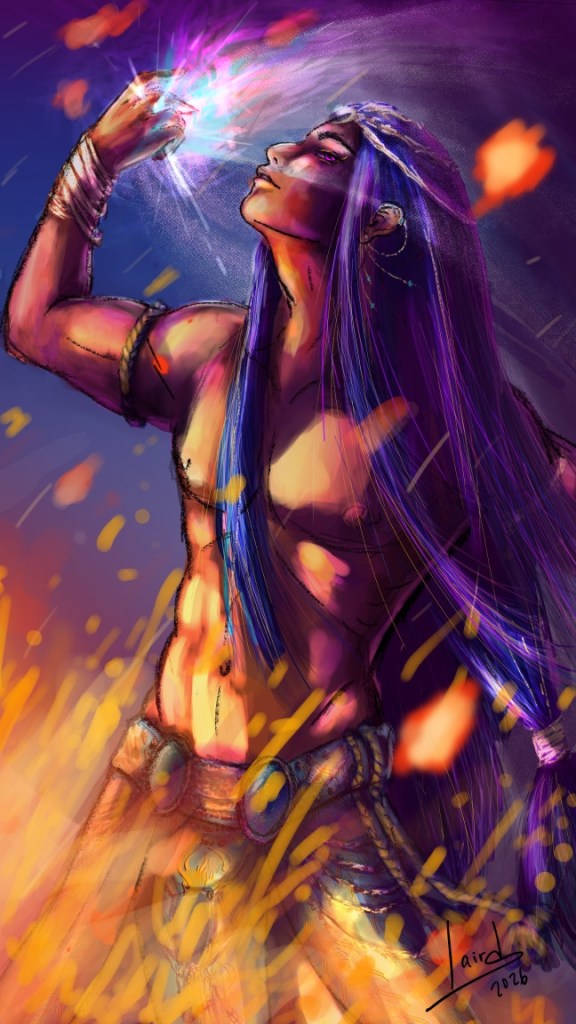
As one of the two points of view in Seventhblade, Elraiche brings an outsider’s narrative to the story. An outsider who is from a foreign land. An outsider who a god walking amongst mortals. His experiences and point of view allow the reader to take a step back from the story and learn from an “unbiased” point of view.
Unbiased, in a very loose sense of the word. Elraiche very clearly has his own agenda, but he is not emotionally or physically tied to any of the factions and peoples in Kaspine, so his opinions are more clinical when it comes to the colonization of the land, the Ibinnas, and the Iqounicha. It also helps that he is very long lived, so his memories act as a witness to the sweeping changes to the governance forced by the Ecrelian monarchy, in their far away lands.
Elraiche’s goals are rarely clear to even those closest to him, but one thing is for sure: anyone caught in his orbit best keep their wits about them, because the exiled god will take any advantage he can to regain what is his.
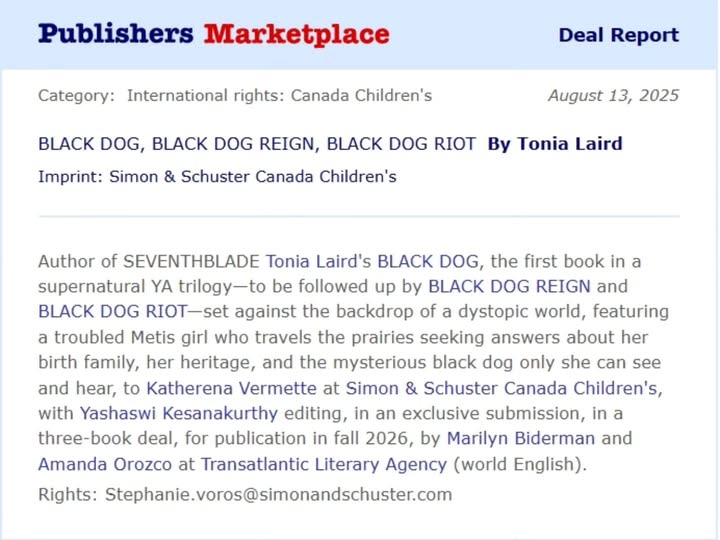
I am so excited to share that I am working on a supernatural, climate-dystopian YA (young adult) trilogy set in the Canadian prairies! Rights to BLACK DOG, BLACK DOG REIGN, and BLACK DOG RIOT were sold to sold to senior editor katherena vermette and children’s editor Yashaswi Kesanakurthy at Simon & Schuster Canada by my agents Marilyn Biderman and Amanda Orozco!
BLACK DOG follows Wren, a young Métis woman, who is travelling across the decades long drought-ravaged prairies in search of answers about her birth family, her heritage, and the ghostly black dog following her every footstep. BLACK DOG is slated for a fall 2026 release!
In Seventhblade, the Ibinnashae (children of Ibinnas and non-Ibinnas) use Northern Michif as their heritage language. I was lucky enough to have translation help from Vince Ahenakew, an educator and language keeper from Île-à-la-Crosse, which one of the main communities that speak this dialect. Vince kindly fixed my attempts at translating dialogue as I am still very new to learning our people’s language. You can book him for speaking engagements, along with other language speakers here.
Michif, on its surface, seems like a simple enough concept. A mix of Cree verbs and French nouns, it became the language of the Métis, people and communities descended from fur trade fathers and Cree mothers. But there are actually multiple dialects of Michif, as each community/region has evolved its own way of speaking. The most common three are:
Michif, on its surface, seems like a simple enough concept. A mix of Cree verbs and French nouns, it became the language of the Métis, people and communities descended from fur trade fathers and Cree mothers. But there are actually multiple dialects of Michif, as each community/region has evolved its own way of speaking. The most common three are:
Heritage Michif – spoken mainly in the central western Manitoba, central Saskatchewan and Alberta, and down into Northern North Dakota and Montana. It’s origins come from the Metis who hunted bison on the plains. This dialect is a mix of Michif French (nouns) and nêhiyawak (Cree) and Saulteaux (Western Ojibwe). Northern Michif – primarily spoken in the northern regions of Saskatchewan and Alberta, Northern Michif is very strongly influenced by nêhiyawak (Cree) and is considered by some to be a dialect of nêhiyawak, with a still noticeable, but obviously lesser French influence. Michif French – spoken in communities that range from western Ontario to central Alberta, Michif French has its roots in older dialects of French, making it unique from Québécois. It is blended with Algonquin languages but is considered closer to a variant of the French language just as Northern Michif is considered a variant of nêhiyawak.
note: some who practice written michif (in all dialects) use the nêhiyawak writing system of no capitalization to avoid unnecessary hierarchy. this is used in seventhblade when northern michif is employed, and with my own name, tonia laird.
The Convenient Lie That Caused the Real Destruction of Thriving Indigenous Farm Communities
In Seventhblade, I’ve used some historical (and contemporary) acts of forced assimilation, segregation, and genocide against Turtle Island Indigenous communities and individuals as a basis for my worldbuilding concerning the Ecrelian colonization of the Indigenous Ibinnas, Ibinnashae, and Iqounicha of Kaspine.
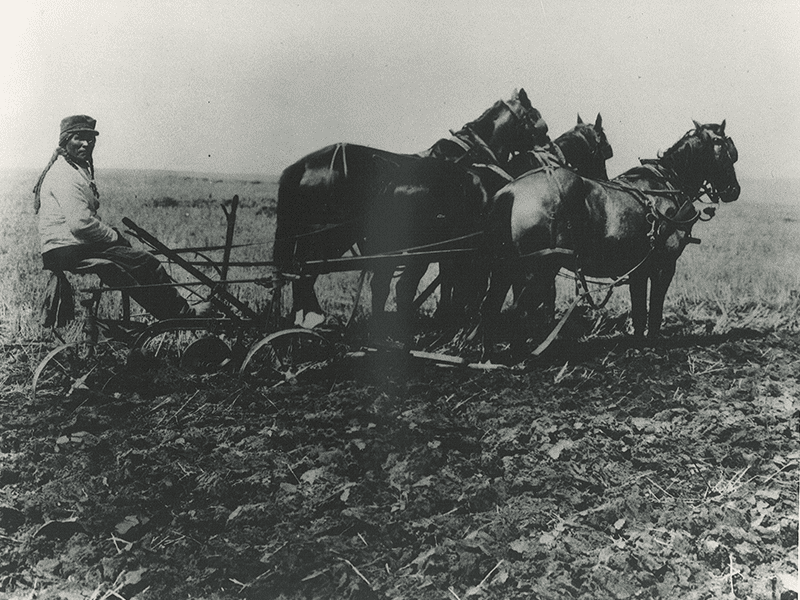
One specific scene alludes to the Peasant Farming Policy enacted by the Canadian Federal government from 1889 to 1897.
Photo Credit: Provincial Archives of Saskatchewan
Minor Spoilers! Read excerpt this blog post is referencing here:
Every Ibinnas and Ibinnashae who live near the colonies has heard of Arrow Woods. The settlement grew much like the village around the Silver Leaf did. The difference? It was one of the last Iquonicha communities. After the Ibinnas and Ecrelians drove the Pheresians from Seventhblade, the remaining Iquonicha were left defenceless.
But in Arrow Woods, they were an established farming settlement. One of the only producers that could feed a city like Seventhblade. So, against the Ibinnas’ wishes to regain their land and send the Iquonicha back to their own, Seventhblade’s viceroy declared that the Iquonicha were allowed to keep their community if they kept the city fed.
So they did.
And they excelled at it.
They kept farming, using a mix of Pheresian and Ecrelian technology alongside their own. They expanded their operations quickly, turning over Ibinnas land, growing foreign grains and vegetables in Ibinnas soil. Even as Ecrelian and Ibinnas relations soured, Arrow Woods grew the vegetables and grains that supported the Ecrelian colonies for over a century.
That is, until it was burned to the ground about five years back. “You’re Iquonicha?” T’Rayles tries to keep her voice gentle, but she
feels a different anger building now. One mixed with an exhaustion so deep and old, it weighs on her bones.
“One of the last.” Bren frowns. “Is that a problem?”
“I don’t think we have the luxury of that being a problem anymore, Bren.” She gives him a rueful smile. “The Ecrelians took care of that.”
“My great-grandfather’s father was one of the first to settle at Arrow Woods. The first to ‘help tame the lands,’ Father always said. He owned the first Ecrelian plow smithed on Kaspine soil.” A small smile ghosts over Bren’s lips.
T’Rayles looks back to the sword in her lap. Ecrelian farmers, when they finally started settling and growing their own crops for profit, felt that they couldn’t compete with Arrow Woods. They complained to the viceroy, who imposed tariffs and sanctions on the community. In the beginning, their harvest was taxed. Then merchants were encouraged to buy only from Ecrelian farmers or face high tariffs themselves.
“My mother, she suggested we go back to the old ways. Shared homes, shared harvest, but keeping it only in the community. Stop growing food that would only rot in our store bins.” Bren frowns. “It worked for a while.”
It did. Until the viceroy sanctioned the community for inciting panic. How? By closing themselves off from their neighbours. By trad- ing only amongst themselves. The viceroy said the Iquonicha promised to help the colony thrive, so why were they keeping their harvest to themselves?
So, the majority of the Arrow Woods harvest, greatly reduced to feed only their own people, went to the private stores of the viceroy himself. “The people of the colonies turned against us. I remember coming into Seventhblade with Father and my two brothers for supplies. The shop owners, they wouldn’t let us in.” Bren shifts and grimaces. T’Rayles can’t tell if it caused by his pain or memory. “They said we were just greedy Iquonicha. That we refused to help them. That we wanted to see them starve.”
So crop production ramped back up. The Silver Leaf started buying from Arrow Woods when T’Rayles brought their problems to Dellan’s attention. The priest didn’t like that. Dellan took the brunt of that, she’s sure.
Soon, another rule came down upon the Arrow Woods Iquonicha. The viceroy declared that since they refused to help the Ecrelian people, they would no longer be permitted to use Ecrelian technology.
But the Arrow Woods Iquonicha refused to give it up. They’d had enough.
And that was enough for Seventhblade’s viceroy to send in his soldiers. His Kaspine Mounted Guard.
“My father sent my mother and me to the city. We took a few of the younger children with us. Mother wasn’t well, but with my help we could have lived here until they sorted out things with the viceroy.” Bren’s words are clipped as he bites out each one. “We didn’t know the brigade we met on the road would be the ones who would burn down our home. Kill our families.”
“Bren . . .” T’Rayles knows she can’t say anything that will help. Arrow Woods was a warning to Silver Leaf. The viceroy and the priest told Dellan as much. The Ibinnas may not be Iquonicha, but in Ecrelian eyes, their blood is the same.
But the Ibinnas and Iquonicha didn’t think that way. Even after all these years, after foreign invaders played old rivalries and hurts between the two nations against the both of them, many Ibinnas refused to take in the survivors of the Iquonicha. Refused people like Bren’s family.
“Mother died less than a year later. She worked to feed all of us. It was too much.” He sniffs. “Anyhow, we’ve been part of— What was it you called us? The kâ wan’sintwâw? We’ve been with them, ever since.”
Even before the bison were driven to near extinction and the Canadian government was well on its way to forcing the Nations living across the prairies to sign the Numbered Treaties through coercion, starvation, and violence, some Indigenous communities had already transitioned to European-styled agriculture. And once treaties were signed, more joined them.
Using their own knowledge of their land and agricultural techniques, working the land collectively, as well as some using treaty-negotiated farming equipment and supplies, these communities thrived to the point that surrounding settlers–many who had no farming experience themselves–could not compete with the Indigenous community’s productivity.
Complaints were made to the federal government, and it became policy to limit the markets where Indigenous people could sell their crops, copying a move made a few years earlier by “Indian Commissioner” Hayter Reed: he did the same thing to punish Indigenous communities for the Northwest Resistance in 1885. This was part of the Pass System. Along with the federal government’s decision to enforce “peasant farming” rules by confiscating treaty-provided and non-treaty-provided tools, equipment, livestock, and supplies, forcing communities to hand-plant their crops, cutting land ownership from 640 acres to 40 acres per family, and announcing that the communities must create all of the tools they plan to use, these policies cut crop production down to almost nothing.
Even the use of carts were banned.
The bureaucrats, including Hayter Reed, who created this policy, used the excuse of Social Darwinism as the reason behind it. Social Darwinism is the disgustingly racist belief that Indigenous people were not as evolved as their white counterparts, and therefore were not yet capable of farming with “modern” techniques and equipment. And that allowing them to do so would cause an “unnatural leap” forward in their sociocultural evolution. Which was obviously a lie as these communities thrived in Canadian markets when they transitioned to European-style agriculture.
But it was never about transitioning Indigenous communities into European society.
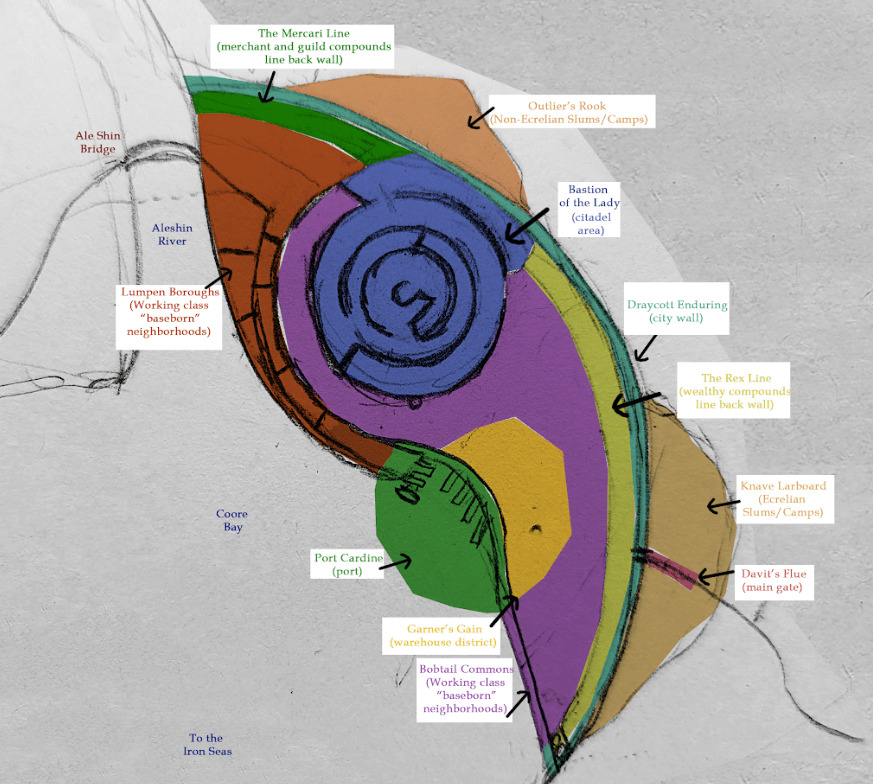
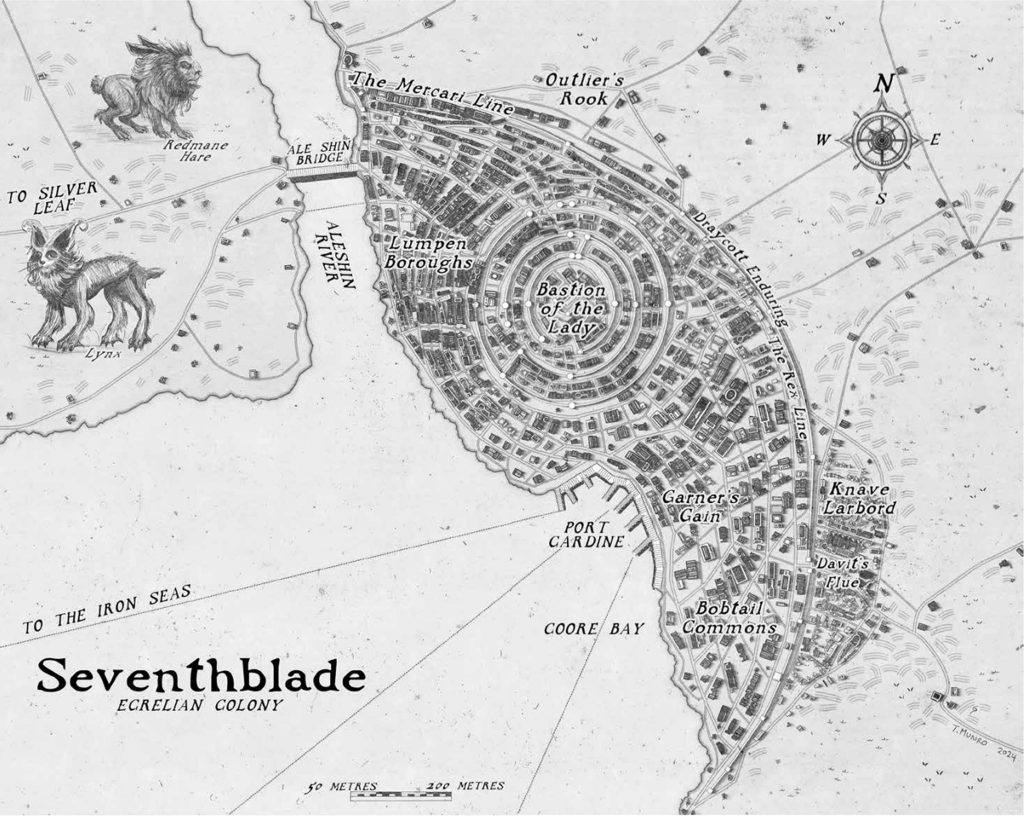
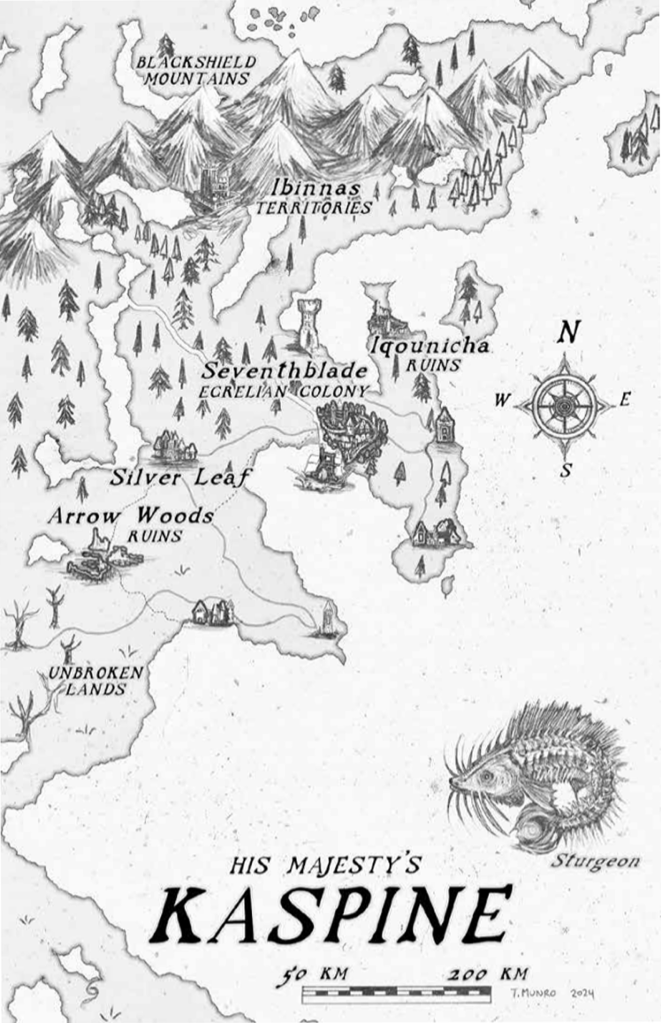
So in the reviews for Seventhblade, I’ve seen a few mention they were really hoping for a map. Unfortunately the illustrator was still working hard on the maps when the ARC went out, so they weren’t included. However, that means the finished book has two glorious maps for readers to reference at their leisure, but reviewers missed out on. So I’ll share them here!
When I thought of the city’s design, I really wanted Seventhblade to have a very colonial/fortress city feel to it, so I created a rough draft myself with the city’s districts and areas defined enough to give an idea of what I was thinking of.
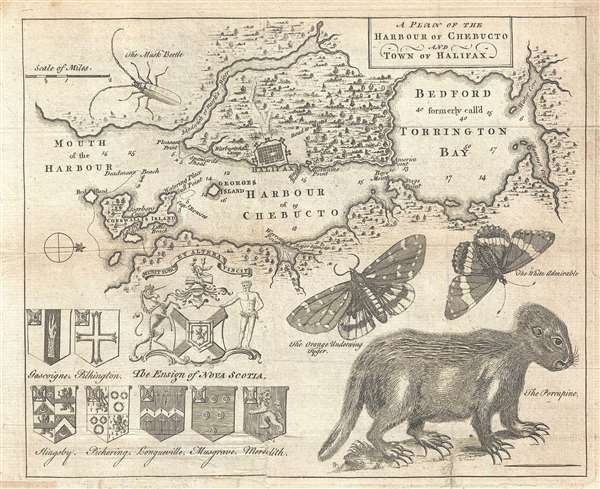
I also included some references, like maps of Halifax, NS, Canada along with other European fortress cities like Palmanova, Italy The illustrator then took all that and created a gorgeous and intricate map of Seventhblade shown below.
Seventhblade
Kaspine
Drawn from the point of view of an Ecrelian mapmaker for their king, the map of the country of Kaspine itself only shows territory Ecrelia has “discovered,” not the full continent.
The country map is intentionally full of inaccuracies as the Ecrelian mapmaker could only work from information given to them by explorers and traders. Seventhblade’s map is much more detailed, as it was built (over the bones of the Ibinnas city) by the Pheresians and Ecrelians.
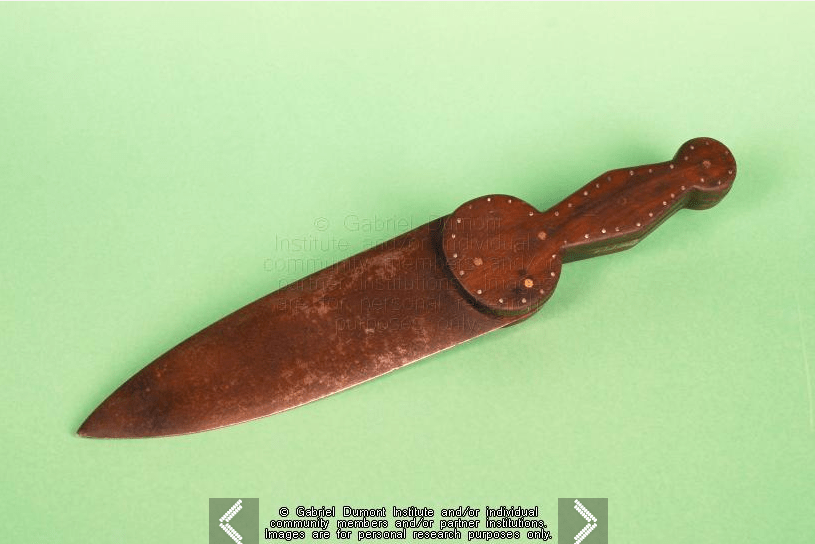
Weapons play a significant role in the world of Seventhblade. T’Rayles’s own dagger is inspired by blades used by the Métis dating back to the 1800s.
T’Rayles carries a beavertail dagger on her belt: it is a common design used by both her and the Ibinnashae of the Broken Fangs, the Ibinnas, and the Iquionicha.
Also known as a dag knife, the beavertail dagger was highly utilitarian and primarily used for practical purposes including hunting, butchering, and skinning, but it can also be used in combat. The blades were also widely used as spear heads by the Métis and Cree during buffalo hunts.
The beavertail dagger’s use was widespread amongst many Nations across Canada and the US in the 1800s and 1900s as the Hudson Bay Company offered it at trading posts.
Sturdy and multi-purpose, their thick blades were just as good for prying as cutting, and many hunters found they could leave hand axes behind and rely on these lighter and more versatile daggers.
The blades were inexpensive to make: cut from sheet iron and exported by the barrel to the Northwest Territories, which at the time, included Saskatchewan. The hilt’s design on this dagger is called a “paddle handle.” It was commonly made of wood fixed with brass and/or pewter pins. These daggers weigh approximately 1 pound, are 12.5 inches long, and 2 inches wide. Sheaths ranged from utilitarian covers to intricate designs created with porcupine quills, glass beads, moose hair, bone, and more.
Authentic beavertail daggers with sheaths have gone for over $10,000 USD at auction.
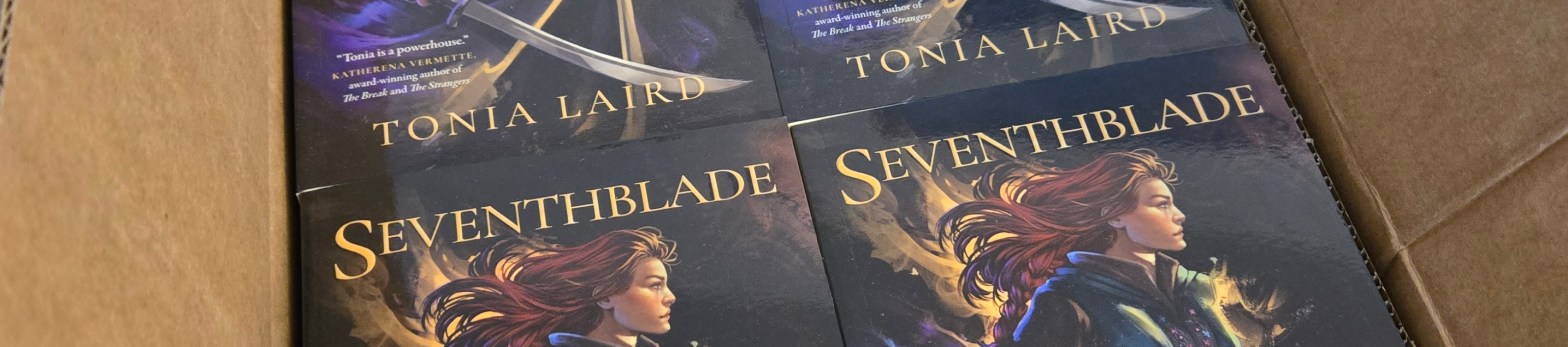
It’s quite the thing, finally seeing your first book in full print like this. Actually holding it in your hands. It’s exciting and surreal; in some ways it felt like a day that was never going to come, especially with the rollercoaster ride of these last few years.
I am so thankful to Jen Albert, the editor of Seventhblade, for her faith in the story and her excellent editorial work.
The cover is illustrated by Jaqueline Florencio, and I think she did a beautiful job bringing the strength and determination of T’Rayles to life.
It’s less than a month and a half to release date and I can’t wait to share this story with everyone.
“We are who we love. A part of us leaves with the ones that go, pieces ripped from us in the worst ways, but part of them stays with us as well. They are woven into everything we do. It is true: Your boy is not here anymore. But you are you because of him, so he will never be gone from you.
Rest, my girl. When you wake, this city will burn with your hunt for your boy’s killer. I can promise you this.“
Set in a fragmented, fascinating world of dangerous magics and cryptic gods, and loaded with complex characters and intricately staged action, Seventhblade is a masterful new fantasy adventure from a bright, emerging Indigenous voice.
For readers of N.K. Jemisin and Rebecca Roanhorse, a fast-paced, anti-colonial action-adventure fantasy that explores twisted power dynamics and the effects of settler colonialism.









 tonia laird