
The Convenient Lie That Caused the Real Destruction of Thriving Indigenous Farm Communities
In Seventhblade, I’ve used some historical (and contemporary) acts of forced assimilation, segregation, and genocide against Turtle Island Indigenous communities and individuals as a basis for my worldbuilding concerning the Ecrelian colonization of the Indigenous Ibinnas, Ibinnashae, and Iqounicha of Kaspine.
One specific scene alludes to the Peasant Farming Policy enacted by the Canadian Federal government from 1889 to 1897.
Minor Spoilers! Read excerpt this blog post is referencing here:
Every Ibinnas and Ibinnashae who live near the colonies has heard of Arrow Woods. The settlement grew much like the village around the Silver Leaf did. The difference? It was one of the last Iquonicha communities. After the Ibinnas and Ecrelians drove the Pheresians from Seventhblade, the remaining Iquonicha were left defenceless.
But in Arrow Woods, they were an established farming settlement. One of the only producers that could feed a city like Seventhblade. So, against the Ibinnas’ wishes to regain their land and send the Iquonicha back to their own, Seventhblade’s viceroy declared that the Iquonicha were allowed to keep their community if they kept the city fed.
So they did.
And they excelled at it.
They kept farming, using a mix of Pheresian and Ecrelian technology alongside their own. They expanded their operations quickly, turning over Ibinnas land, growing foreign grains and vegetables in Ibinnas soil. Even as Ecrelian and Ibinnas relations soured, Arrow Woods grew the vegetables and grains that supported the Ecrelian colonies for over a century.
That is, until it was burned to the ground about five years back. “You’re Iquonicha?” T’Rayles tries to keep her voice gentle, but she
feels a different anger building now. One mixed with an exhaustion so deep and old, it weighs on her bones.
“One of the last.” Bren frowns. “Is that a problem?”
“I don’t think we have the luxury of that being a problem anymore, Bren.” She gives him a rueful smile. “The Ecrelians took care of that.”
“My great-grandfather’s father was one of the first to settle at Arrow Woods. The first to ‘help tame the lands,’ Father always said. He owned the first Ecrelian plow smithed on Kaspine soil.” A small smile ghosts over Bren’s lips.
T’Rayles looks back to the sword in her lap. Ecrelian farmers, when they finally started settling and growing their own crops for profit, felt that they couldn’t compete with Arrow Woods. They complained to the viceroy, who imposed tariffs and sanctions on the community. In the beginning, their harvest was taxed. Then merchants were encouraged to buy only from Ecrelian farmers or face high tariffs themselves.
“My mother, she suggested we go back to the old ways. Shared homes, shared harvest, but keeping it only in the community. Stop growing food that would only rot in our store bins.” Bren frowns. “It worked for a while.”
It did. Until the viceroy sanctioned the community for inciting panic. How? By closing themselves off from their neighbours. By trad- ing only amongst themselves. The viceroy said the Iquonicha promised to help the colony thrive, so why were they keeping their harvest to themselves?
So, the majority of the Arrow Woods harvest, greatly reduced to feed only their own people, went to the private stores of the viceroy himself. “The people of the colonies turned against us. I remember coming into Seventhblade with Father and my two brothers for supplies. The shop owners, they wouldn’t let us in.” Bren shifts and grimaces. T’Rayles can’t tell if it caused by his pain or memory. “They said we were just greedy Iquonicha. That we refused to help them. That we wanted to see them starve.”
So crop production ramped back up. The Silver Leaf started buying from Arrow Woods when T’Rayles brought their problems to Dellan’s attention. The priest didn’t like that. Dellan took the brunt of that, she’s sure.
Soon, another rule came down upon the Arrow Woods Iquonicha. The viceroy declared that since they refused to help the Ecrelian people, they would no longer be permitted to use Ecrelian technology.
But the Arrow Woods Iquonicha refused to give it up. They’d had enough.
And that was enough for Seventhblade’s viceroy to send in his soldiers. His Kaspine Mounted Guard.
“My father sent my mother and me to the city. We took a few of the younger children with us. Mother wasn’t well, but with my help we could have lived here until they sorted out things with the viceroy.” Bren’s words are clipped as he bites out each one. “We didn’t know the brigade we met on the road would be the ones who would burn down our home. Kill our families.”
“Bren . . .” T’Rayles knows she can’t say anything that will help. Arrow Woods was a warning to Silver Leaf. The viceroy and the priest told Dellan as much. The Ibinnas may not be Iquonicha, but in Ecrelian eyes, their blood is the same.
But the Ibinnas and Iquonicha didn’t think that way. Even after all these years, after foreign invaders played old rivalries and hurts between the two nations against the both of them, many Ibinnas refused to take in the survivors of the Iquonicha. Refused people like Bren’s family.
“Mother died less than a year later. She worked to feed all of us. It was too much.” He sniffs. “Anyhow, we’ve been part of— What was it you called us? The kâ wan’sintwâw? We’ve been with them, ever since.”
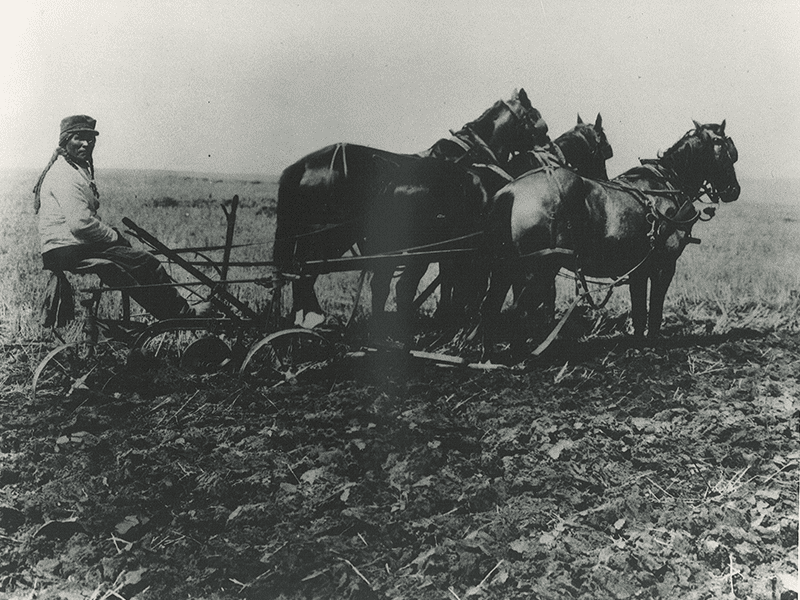
Even before the bison were driven to near extinction and the Canadian government was well on its way to forcing the Nations living across the prairies to sign the Numbered Treaties through coercion, starvation, and violence, some Indigenous communities had already transitioned to European-styled agriculture. And once treaties were signed, more joined them.
Using their own knowledge of their land and agricultural techniques, working the land collectively, as well as some using treaty-negotiated farming equipment and supplies, these communities thrived to the point that surrounding settlers–many who had no farming experience themselves–could not compete with the Indigenous community’s productivity.
Complaints were made to the federal government, and it became policy to limit the markets where Indigenous people could sell their crops, copying a move made a few years earlier by “Indian Commissioner” Hayter Reed: he did the same thing to punish Indigenous communities for the Northwest Resistance in 1885. This was part of the Pass System. Along with the federal government’s decision to enforce “peasant farming” rules by confiscating treaty-provided and non-treaty-provided tools, equipment, livestock, and supplies, forcing communities to hand-plant their crops, cutting land ownership from 640 acres to 40 acres per family, and announcing that the communities must create all of the tools they plan to use, these policies cut crop production down to almost nothing.
Even the use of carts were banned.
The bureaucrats, including Hayter Reed, who created this policy, used the excuse of Social Darwinism as the reason behind it. Social Darwinism is the disgustingly racist belief that Indigenous people were not as evolved as their white counterparts, and therefore were not yet capable of farming with “modern” techniques and equipment. And that allowing them to do so would cause an “unnatural leap” forward in their sociocultural evolution. Which was obviously a lie as these communities thrived in Canadian markets when they transitioned to European-style agriculture.
But it was never about transitioning Indigenous communities into European society.
It was only about controlling them.
References:
https://teaching.usask.ca/indigenoussk/import/indigenous_reserve_agriculture_to_1900.php
https://www.thecanadianencyclopedia.ca/en/article/peasant-farm-policy
For kids (but honestly, a great resource for everyone):
https://exploresaskag.ca/past/first-nations-and-agriculture/preventing-success/
https://exploresaskag.ca/past/indian-act-and-treaties/pass-and-permit-system/
 tonia laird
So incredibly sad. So incredibly racist.
LikeLike